


Learning styles have shaped conversations in education and workplace training for decades. Many people identify as visual, auditory, or hands-on learners, using these categories to describe how they prefer to engage with new information.
But does matching training to a person’s preferred learning style actually improve learning outcomes?
In this blog, we’ll explain what learning styles are, explore the most common learning style frameworks, examine what current research says about their effectiveness, and share evidence-based strategies for designing training that helps all learners succeed.
Key takeaways
- Learning styles reflect preferences, not learning ability. While people may prefer visual, auditory, reading/writing, or hands-on learning, research shows that these preferences don’t determine how well they learn. Most people benefit from a combination of learning methods depending on the topic and context.
- There’s little evidence that matching training to learning styles improves outcomes. Despite the popularity of models like VARK, current research finds limited support for the idea that tailoring instruction to a learner’s preferred style leads to better knowledge retention or performance. Instead, using multiple instructional methods is generally more effective.
- Multimodal, task-focused training is more effective than separate learning-style courses. Rather than creating separate training versions for different learner types, organizations should combine videos, text, visuals, discussions, quizzes, and hands-on practice. The format should be chosen based on the content and skills being taught, not individual learning preferences.
- Learning preferences still matter because they boost engagement and accessibility. Although they shouldn’t drive instructional design, understanding learner preferences can increase motivation, encourage better study habits, and make training more inclusive by offering content in multiple formats.
- Evidence-based learning strategies produce the strongest results. Focus on cognitive science-backed techniques such as spaced repetition, retrieval practice, combining words with visuals, active learning, real-world application, and using Bloom’s Taxonomy to help learners progress from remembering information to applying, analyzing, evaluating, and creating.
What are learning styles?
Learning styles describe the different ways people prefer to receive, process, and engage with new information. At its core, the idea recognizes that learners may naturally gravitate toward certain methods or formats when interacting with educational or training materials and developing new skills.
For example, some learners find diagrams and visual representations easier to understand than written explanations, while others prefer listening to presentations or gaining experience through hands-on practice. These tendencies can influence how learners approach new information and which training methods they find most engaging.
However, it’s important to distinguish between learning preferences and learning ability.
Someone who enjoys visual content can still learn effectively through discussion or hands-on practice, just as someone who prefers reading can benefit from demonstrations or collaborative exercises.
In reality, most people use a combination of learning methods depending on the subject, environment, and task at hand.
Understanding these preferences can help organizations create more engaging and accessible learning experiences. As we’ll explore later, though, learner preferences are only one part of what makes training effective.
The VARK model
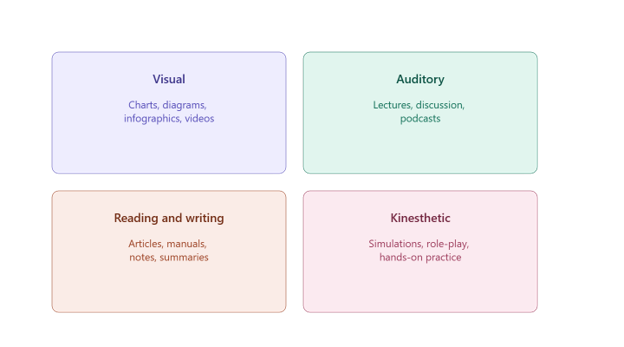
One of the most well-known learning style frameworks is the VARK model, which groups learning preferences into four categories: Visual, Auditory, Reading/Writing, and Kinesthetic. While individuals may identify more strongly with one category than another, many learners benefit from a combination of these approaches.
- Visual learners: Prefer information presented through images and graphics, such as charts, diagrams, infographics, flowcharts, and videos. Visual representations can help simplify complex concepts and make it easier to recognize patterns, relationships, and processes.
- Auditory learners: Often prefer learning through listening and discussing ideas. Lectures, podcasts, conversations, and verbal explanations can help reinforce understanding, while talking through concepts or asking questions often strengthens retention.
- Reading and writing learners: Prefer working with text-based materials, including articles, manuals, reports, and written instructions. They often reinforce their understanding by taking detailed notes, rewriting information in their own words, or creating summaries and lists.
- Kinesthetic learners: Often prefer hands-on experiences. Activities such as simulations, role-playing, practical demonstrations, and experiments allow them to apply concepts in real-world situations and build confidence through practice.
Although the VARK model separates learners into four categories, few people fit neatly into just one. Learning preferences often overlap, and many individuals naturally use different approaches depending on what they’re learning.
Other learning style frameworks
While the VARK model is one of the most widely recognized learning style frameworks, it’s not the only one.
Other models expand on the concept by considering how people prefer to interact with information, solve problems, and engage with others.
Some of these learning styles include:
- Social learners: Thrive in collaborative environments and often learn best through discussions, group projects, peer learning, and sharing ideas with others.
- Solitary learners: Prefer independent study and self-paced learning. These learners often enjoy reflecting on concepts, setting personal goals, and working through material on their own.
- Logical learners: Like to identify patterns, analyze information, and understand the reasoning behind concepts. Problem-solving activities and structured thinking often help them grasp new ideas.
- Verbal learners: Process information most effectively through spoken or written language. Reading, writing, storytelling, and discussion can all help reinforce their understanding.
Understanding these differences can help organizations create more flexible and engaging learning experiences.
However, an important question remains: does tailoring training to someone’s preferred learning style actually improve learning outcomes?
Do learning styles actually improve learning outcomes?
Learning styles have been widely discussed in education and workplace training for years, but researchers continue to debate whether tailoring instruction to an individual’s preferred learning style actually leads to better results.
Current research has highlighted a few key insights:
- There’s limited evidence that matching instruction to a learner’s preferred style improves outcomes: While people may gravitate toward certain ways of learning, those preferences don’t necessarily lead to better knowledge retention or performance.
- Learning styles aren’t universally defined or measured: Numerous frameworks exist, each categorizing learners differently, making it difficult for researchers to draw consistent, evidence-based conclusions across studies.
- Using multiple teaching methods appears to be more effective: Combining visuals, written resources, discussions, and hands-on activities often creates stronger learning experiences by reinforcing concepts in multiple ways.
This doesn’t mean learner preferences should be ignored. Understanding how people prefer to engage with information can still help increase motivation, participation, and accessibility.
However, when designing training, the goal isn’t to build four separate courses for four different types of learners. Instead, organizations should focus on creating learning experiences that are evidence-based and effective for everyone.
Why understanding learning preferences still matters
While learning preferences shouldn’t be the foundation of instructional design, they can still play an important role in creating more flexible, inclusive learning experiences.
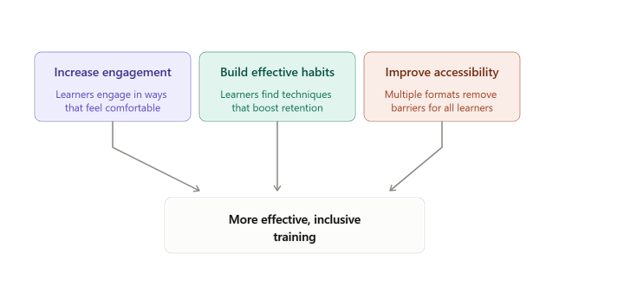
Understanding different learning styles can help organizations:
- Increase engagement: When learners interact with content in ways they find comfortable and intuitive, they’re often more motivated to participate. For example, one learner may be more engaged by diagrams and videos, while another may prefer discussions or hands-on activities.
- Encourage more effective learning habits: Recognizing learning preferences can help employees identify techniques that improve comprehension and retention. For example, someone who finds lengthy documents overwhelming may prefer to create visual summaries, while another may reinforce new concepts by discussing them with a colleague or recording voice notes.
- Improve accessibility and inclusivity: Providing information in multiple formats — such as videos with captions, written guides, interactive activities, and instructor-led discussions — gives learners more opportunities to engage with the material and removes barriers for different audiences.
Ultimately, learning preferences should be viewed as a way to increase engagement rather than a rule for designing instruction.
The most effective training programs combine a variety of evidence-based teaching methods that help learners understand, retain, and apply new knowledge.
Creating effective training for different learning styles
Rather than creating separate training programs for different learning styles, today’s instructional designers focus on building flexible learning experiences that support a wide range of learners.
Here are four strategies organizations can use to create more effective training for different learning styles.
Create multimodal learning experiences
Most people don’t rely on just one learning style. Instead, they learn best when information is presented through multiple formats that reinforce one another. This approach, known as multimodal learning or dual coding combines different types of content within the same learning experience.
Consider incorporating a mix of:
- Instructional videos
- Written resources
- Diagrams and infographics
- Interactive quizzes
- Group discussions or elaboration
- Hands-on practice
Using multiple formats helps learners engage with information in ways that feel most natural to them while reinforcing concepts from different perspectives. It also improves accessibility by allowing learners to interact with content in different ways, creating a more flexible and inclusive training experience.
Match the content to the task
One of the biggest misconceptions about learning styles is that every learner should receive information in their preferred format. In reality, the type of content being taught should play a much bigger role in determining how it’s delivered.
Different subjects naturally lend themselves to different instructional methods. For example:
- Software training: Screen recordings and live demonstrations can make it easier for learners to follow processes and understand how tools work.
- Leadership development: Coaching conversations, group discussions, and role-playing activities help learners practice communication and decision-making skills.
- Compliance training: Realistic workplace scenarios make policies and procedures more relatable and easier to apply.
- Data and analytics: Charts, dashboards, and visualizations help learners identify patterns and interpret complex information.
- Step-by-step processes: Diagrams, flowcharts, and interactive walkthroughs can simplify complex workflows and guide learners through each stage.
Choosing the right format for the content helps learners understand concepts more quickly and apply them more effectively.
Incorporate active learning
Learners are more likely to retain information when they actively engage with the material rather than simply reading it or watching a presentation.
Active learning can include:
- Discussions
- Simulations
- Case studies
- Role-playing exercises
- Collaborative projects
- Knowledge checks and quizzes
These activities encourage learners to participate, practice new skills, and connect concepts to real-world situations.
Creating a supportive learning environment is also important, as learners are more likely to engage when they feel comfortable asking questions, sharing ideas, and working through challenges.
Build learning using Bloom’s Taxonomy
While learning styles focus on how people prefer to receive information, Bloom’s Taxonomy provides a framework for understanding how learning develops over time.
Developed by educational psychologist Benjamin Bloom, the model organizes learning into six progressive levels. Each stage builds upon the one before it, helping learners move from basic understanding to higher-order thinking and problem-solving.
The six stages include:
- Remember: Recall facts, definitions, or procedures.
- Understand: Explain concepts and demonstrate comprehension.
- Apply: Use new knowledge in practical situations.
- Analyze: Identify relationships, patterns, and underlying causes.
- Evaluate: Make informed decisions using evidence and critical thinking.
- Create: Develop new ideas, solutions, or innovations based on what has been learned.
Effective workplace training shouldn’t stop once learners can remember information. Instead, it should guide them toward applying their knowledge, solving problems independently, and eventually using what they’ve learned to improve processes or generate new ideas.
Using Bloom’s Taxonomy when designing training courses also helps establish clear learning objectives, ensuring every activity supports a meaningful progression from foundational knowledge to practical workplace performance.
What cognitive science says about learning
Research in cognitive science has shifted the conversation away from learning styles and toward strategies that consistently improve learning outcomes.
One of the most important findings is that learning doesn’t end when information is first introduced. Instead, it happens when learners can successfully retrieve, apply, and build on what they’ve learned over time.
Research has identified several evidence-based strategies that organizations can incorporate into their training programs, including:
- Spaced repetition: Rather than reviewing information once or cramming it into a single session, learners return to key concepts over gradually increasing intervals. Revisiting important concepts throughout a training program helps reinforce learning and makes knowledge easier to recall over time.
- Retrieval practice: Instead of rereading notes, learners should actively recall information through quizzes, reflection prompts, or practice questions. Research consistently shows that self-testing — even informally — is one of the most effective ways to strengthen memory and improve long-term learning.
- Combine words and visuals: People are more likely to understand and remember information when written or spoken explanations are paired with diagrams, charts, illustrations, or other visual aids. Presenting information in multiple formats can make complex concepts easier to process and recall.
- Apply learning through practice: Learners develop a deeper understanding when they actively use new knowledge rather than simply reading or listening to it. Incorporating problem-solving exercises, discussions, simulations, and hands-on activities helps learners apply concepts in realistic situations and build the confidence to use them in the workplace.
- Connect learning to real-world situations: Learners are more likely to remember information when it’s relevant to their roles, goals, or everyday experiences. Using realistic workplace scenarios and practical examples helps learners see the value of the content and makes it easier to apply on the job.
By incorporating these evidence-based techniques into training programs, organizations can help learners better understand, retain, and apply new knowledge.
Using LEAi
To help organizations create more effective training experiences, we created LEAi, an AI-powered tool that helps teams develop content for both online learning and instructor-led training (ILT).
You don’t need to be an instructional design expert to use LEAi. The platform makes it easier for teams across HR, learning and development, and other business functions to transform existing content into structured learning experiences that support effective training practices.
Some of LEAi’s key benefits include:
- Creating training content from existing organizational materials
- Guidance based on instructional design best practices
- Quickly updating courses with automated content updates
- Translating learning materials into multiple languages
- Repurposing content across different formats and delivery methods
- Creating microlearning modules with one click
- Supporting blended learning and multiple training approaches
If you’re looking to design training that supports a range of learners through effective, evidence-based strategies, LEAi can help you create engaging learning experiences faster — reach out to us!
FAQ
What are learning styles?
Learning styles describe the different ways people prefer to receive, process, and interact with new information. Common frameworks categorize learners based on preferences such as visual, auditory, reading/writing, or hands-on learning. However, most people use a combination of approaches depending on the situation and the type of content.
What are the most common learning style frameworks?
The VARK model is one of the most widely recognized learning style frameworks, categorizing learners as Visual, Auditory, Reading/Writing, or Kinesthetic. Other frameworks explore preferences related to collaboration, independent learning, problem-solving, and communication styles.
Do learning styles actually improve learning outcomes?
Research has found limited evidence that matching training to a person’s preferred learning style improves learning outcomes. Instead, effective training focuses on evidence-based strategies such as using multiple content formats, providing practice opportunities, and helping learners apply new knowledge.
How can organizations design training for different learning preferences?
Organizations can create more effective training by using a mix of formats, including videos, written resources, visuals, discussions, and hands-on activities. The goal is not to create separate courses for each learning style, but to design flexible learning experiences that support a wide range of learners.