

Micro-credential programs are fast becoming a strategic bridge between education and employment—especially in sectors like healthcare, construction, and cybersecurity, where demand is high and timely credentialing is critical.
These programs offer more flexibility, faster time-to-skill, and better alignment with employer needs than traditional four-year degrees. They also give professionals a way to showcase their expertise and commitment to their careers.
But building a micro-credential program can been slow, costly, and challenging to scale. Traditional methods require months of content development, manual exam creation, and expensive in-person proctoring. For executives, that means higher program costs, longer timelines, and limited global reach.
AI is changing that. By streamlining course development, strengthening exam design, and securing online testing, AI makes micro-credential programs faster, more cost-effective, and more credible than ever.
Course development
Developing training materials is often the longest and most resource-intensive part of launching a certification.
AI drastically compresses this timeline. It can analyze regulations, industry research, and internal documents to create draft content that instructional designers and SMEs refine, allowing teams to focus on quality and engagement rather than starting from scratch.
Example: OpenText uses AI to generate and refine course materials, including learning objectives, knowledge checks, and rewritten modules in more engaging formats. AI also transforms existing assets (like presentations and training videos) into complete eLearning modules and provides fast, accurate translation for global learners.
The results: 38%–69% faster development, without sacrificing quality and with improved accessibility worldwide.
Why this matters to executives:
- Speed to market: Launch programs in weeks, not months.
- Cost savings: Reduce reliance on SMEs and designers.
- Scalability: Quickly update content as regulations and technologies evolve.
- Personalization: Tailor learning to different roles and experience levels.
Exam design
Strong exams drive the credibility of any certification. But building reliable question banks that align with objectives and meet compliance standards is notoriously difficult.
AI accelerates this work by generating large volumes of high-quality, reference-backed questions that cover both recall and scenario-based reasoning. It also analyzes performance data to identify ambiguous or ineffective items.
Example: Actian needed to scale exams without compromising quality. The team spent days manually extracting information from documentation and videos to craft realistic questions. With AI, Actian now generates aligned exam blueprints, automated question banks, and both recall- and reasoning-based questions with high-quality distractors.
The outcome: 90% reduction in development time, consistent question quality, and significantly faster certification rollout.
Why this matters to executives:
- Stronger exam integrity: Diverse question banks reduce memorization and cheating.
- Defensible assessments: Reference-backed questions help avoid compliance risks.
- Efficiency gains: Development time drops by up to 90%.
Proctoring
Even the best exam fails if integrity is compromised. While in-person proctoring is secure, it’s costly and limits access. Traditional remote proctoring without safeguards risks cheating.
AI-powered proctoring solves both issues. These systems use biometrics, behavioural analysis, and real-time monitoring to verify identity, track eye movements, monitor the testing environment, and ensure fair conditions for thousands of candidates.
Example: A major certification body migrated 10,000+ high-stakes exams online using AI-based proctoring. With browser lockdown, live invigilation, facial recognition, and post-exam anomaly detection, they achieved:
- Near-zero identity fraud
- Manual proctor involvement: 80% reduction
- Feedback from candidates: 90%+ positive fairness
- Incident resolution time: cut from 8+ minutes to under 2
- Scalability: from 500 to 5,000+ concurrent candidates
- Administration costs: 65% lower per exam
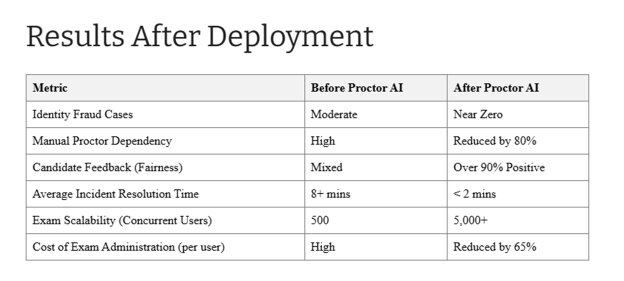
Source: Case Study: AI Powered Remote Proctoring with Proctor AI
Why this matters to executives:
- Scalability: Test thousands of learners worldwide.
- Accessibility: Enable remote workers and global teams to test anytime.
- Cost efficiency: Significant savings compared to in-person centers.
- Reputation protection: Preserve exam credibility and organizational trust.
FAQs
What is a micro-credential program?
A micro-credential program is a focused certification that validates specific skills or competencies. Unlike traditional degrees, micro-credentials are shorter, faster to complete, and closely aligned with employer and industry needs.
Why are micro-credentials growing in popularity?
They provide faster time-to-skill, flexible learning pathways, and clear proof of expertise—especially in high-demand sectors like healthcare, construction, cybersecurity, and technology. They help organizations close skill gaps quickly and advance professionals’ careers.
What challenges do organizations face when launching micro-credential programs?
Common challenges include:
- Long content development timelines
- Manual and resource-heavy exam creation
- High SME and instructional design costs
- Limited scalability
- Expensive in-person proctoring requirements
- Compliance and exam integrity concerns
How does AI accelerate course development for a micro-credential program?
AI analyzes regulations, research, and internal documentation to generate draft learning objectives, course outlines, knowledge checks, and full modules. It can also convert presentations and training videos into structured eLearning and translate content for global audiences.
Impact: 38%–69% faster development while maintaining quality and accessibility.
Does AI replace instructional designers or SMEs?
No. AI handles the heavy lifting—drafting, structuring, and organizing content—while instructional designers and subject matter experts refine, validate, and enhance it. It acts as a productivity multiplier, not a replacement.
How does AI improve exam design?
AI generates large, objective-aligned question banks with reference-backed content. It supports both recall and scenario-based reasoning questions and analyzes performance data to identify weak or ambiguous items.
Impact: Up to 90% reduction in development time; Stronger exam integrity; More defensible, compliance-ready assessments.
How does AI strengthen exam security?
AI-powered proctoring uses biometric verification, behaviour analysis, browser lockdown, and anomaly detection to ensure secure, scalable online testing.
Results from large-scale implementations: Near-zero identity fraud, 80% reduction in manual proctor involvement, 65% lower administration costs per exam and 5,000+ concurrent candidate scalability.
Is AI-based proctoring as credible as in-person testing?
Yes. Modern AI systems provide continuous monitoring, identity verification, and post-exam analytics that often exceed the consistency of traditional in-person proctoring, while dramatically expanding access.
What are the executive-level benefits of using AI in micro-credentials?
Speed to market: Launch in weeks, not months
Cost efficiency: Lower development and proctoring costs
Scalability: Support global learners at scale
Integrity: Strengthen exam credibility and compliance
Competitive advantage: Respond quickly to workforce and regulatory changes
Use LEAi for your micro-credential program
Organizations can now build and scale highly credible certifications in a fraction of the time and cost. For executives navigating rapid digital change, regulatory pressure, and global workforce needs, AI offers a clear competitive advantage.
Our LEAi tool helps organizations streamline curriculum development, exam design, and content transformation so they can build high-quality, defensible micro-credential programs in a fraction of the time. It accelerates development while maintaining instructional rigour and assessment integrity.
Contact us, if your organization relies on training and certification to drive performance or compliance!