


Partnering with an individual or company can be a great way to gain access to a wider range of services, expertise, or reach. But successful partnerships require effort and commitment on both sides of the partnership. You need to invest time and resources to make the relationship successful, and to ensure your partners address your product(s)/solution(s) in the best way they will require specific enablement as part of that investment.
In my past experiences, I have taken ownership of partner enablement and successfully developed programs from scratch. However, I have also encountered partner programs that have fallen short and failed to produce the desired results.
One major factor that determines the success of these programs is how effectively the stakeholders at the partner companies are equipped with knowledge about the partnership, the associated benefits, the partnering organization, and their product/solution.
In this blog, we’ll explore some strategies and tactics for building an effective partner enablement plan ensuring your program is positioned for success!
Key takeaways
- Partner enablement equips partners to succeed on your behalf — it covers training, tools, resources, and knowledge so partners can sell, support, or deliver your product effectively.
- Not all partners need the same program. Marketing, reselling, and services partnerships each require different training content and different success metrics.
- Enablement should start with goals and KPIs, not content. Define what success looks like for each partner type before building training.
- Role-specific learning paths matter. A partner’s sales team and support team often need different training tracks, not one generic course.
- Certification and tracking close the loop. Partner agreements should specify learning expectations, and progress should be tracked and communicated regularly.
- AI tools like LEAi cut time-to-market by turning existing internal content into partner-ready training in minutes instead of months.
What is partner enablement?
Partner enablement is the process of equipping external partners — resellers, marketing partners, or services partners — with the tools, resources, and knowledge they need to successfully meet the goals of a partnership. It typically includes onboarding, product and technical training, sales and marketing enablement, certification, and ongoing support resources.
Done well, partner enablement strengthens the partnership, builds trust, and drives mutual revenue growth. Done poorly — with outdated materials, no clear learning path, or one-size-fits-all training — it leaves partners under-informed and unable to represent your product accurately.
What are the benefits of a partner enablement program?
A strong partner enablement program produces four measurable business outcomes:
| Benefit | How it happens |
|---|---|
| Increased sales and revenue | Trained partners sell and position products more effectively |
| Improved customer satisfaction | Partners with strong technical training deliver better support and implementation |
| Expanded market reach | Enabled partners can confidently represent you in new regions or segments |
| Stronger partner relationships | Clear expectations and support reduce friction and build trust |
What types of partnerships need enablement?
Most partner enablement programs need to support three common partnership types, each with different goals and training needs:
| Partnership type | What it involves | Example goal |
|---|---|---|
| Marketing partnership | Two companies promote each other’s products to their customer bases | Grow market share in a new region |
| Reselling partnership | A partner sells your product through their own sales channels | Increase the number of installs in a target market |
| Services partnership | Two companies offer complementary services to shared clients | Deliver localized training or customization services |
A single partner may fall into more than one category, and each type requires a different enablement strategy — a reseller needs deep product and sales training, while a marketing partner may only need brand and positioning basics.
How do you build a partner enablement framework?
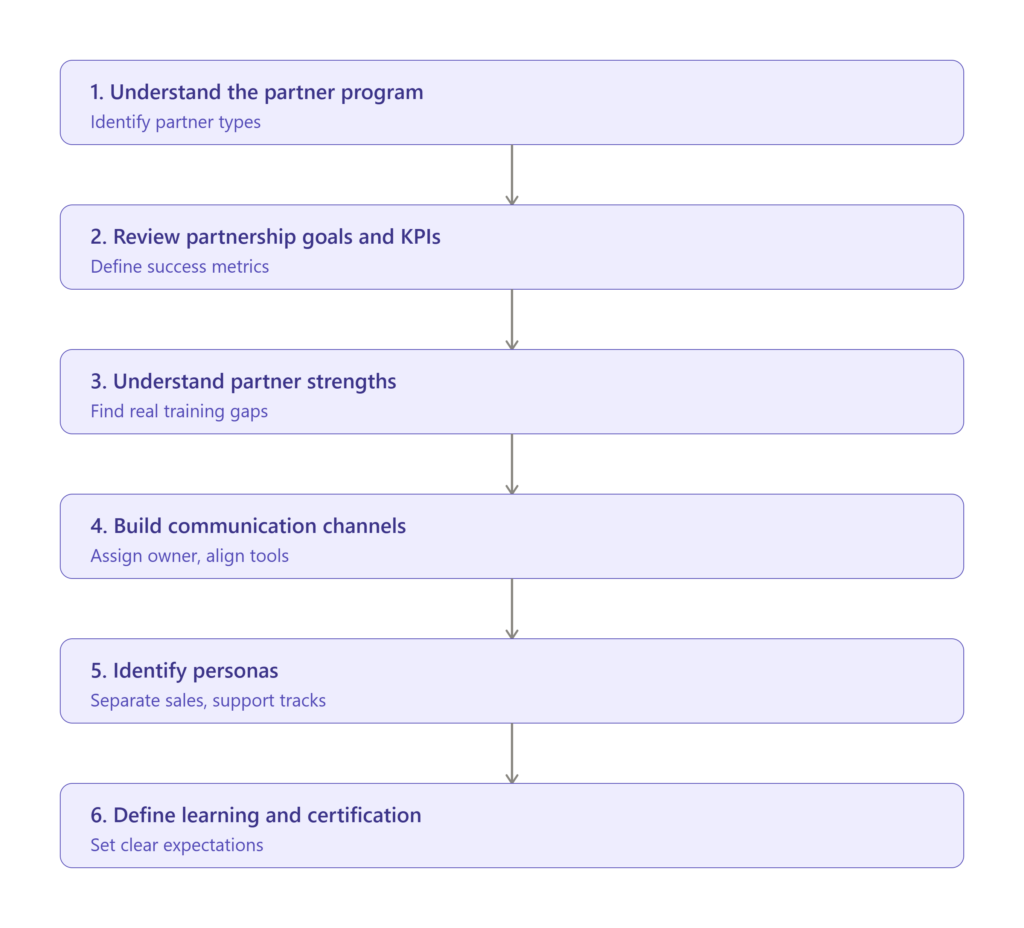
Building an effective partner enablement framework involves six steps:
- Understand the partner program. Identify which partner types you’re enabling (marketing, reselling, services) since the required training differs by type.
- Review partnership goals and KPIs. Define what success looks like before building any content — for example, lead volume for a marketing partner or install count for a reseller.
- Understand partner strengths. Identify what each partner already does well so enablement can focus on filling real gaps rather than duplicating strengths.
- Build communication channels. Assign a partner enablement manager, set up regular check-ins, and align CRM or collaboration tools between organizations.
- Identify personas within the partner organization. A partner’s sales team, support team, and technical team often need separate training tracks.
- Define learning and certification expectations. Set clear learning paths and certification requirements per persona, and include them in the partner agreement so expectations are formal, not implied.
Example partnership goals and KPIs by type
| Partnership type | Example goal | Example KPI |
|---|---|---|
| Marketing | Build brand presence in a new country | Number and quality of leads generated |
| Reselling | Introduce the product in a new market | Number of new customers or installs |
| Services | Deliver localized training to customers | Number of completed integrations or support tickets |
What should a partner enablement program include?
A complete partner enablement program has six core elements:
1. Onboarding. Start with company background, brand, mission, and product overview — much of this can be adapted from existing internal employee onboarding content rather than built from scratch.
2. Technical enablement. Give partners in-depth product training through instructor-led sessions, workshops, or eLearning so they understand your product’s ins and outs.
3. Sales and marketing training. Beyond product knowledge, train partners on positioning, competitive differentiation, objection handling, and how to identify customer pain points.
4. Tools and resources. Give partners access to a shared CRM, support ticketing system, presentation decks, and a learning management system (LMS) to deliver and track training. Course authoring tools (like LEAi) also let partners build or adapt training themselves.
5. Continuous evaluation. Regularly measure the program against your defined KPIs, and collect qualitative feedback directly from partners.
6. Continuous improvement. Use KPI data and partner feedback to prioritize updates, and keep training current as your product and organization evolve.
What tools do you need for partner enablement?
| Tool category | Purpose | Examples |
|---|---|---|
| CRM | Track leads and partner-sourced opportunities | HubSpot, Salesforce |
| Support ticketing | Let partners log bugs or get product support directly | Your existing support portal |
| Course authoring software | Let partners build or adapt training content | LEAi |
| Learning management system (LMS) | Deliver and track partner training completion | Docebo, SkillJar |
| Presentation decks | Give partners editable materials for their own customer conversations | Branded, customizable slide templates |
How often should you update a partner training program?
Partner training should be updated any time there’s a material product change, pricing change, or positioning shift — waiting for an annual refresh leaves partners representing outdated information to customers.
In practice, this means treating partner content as a living asset with an owner responsible for pushing updates, not a one-time deliverable. Tools that let you regenerate training from existing internal content (like updated internal docs or sales decks) make frequent updates realistic instead of a resourcing burden.
How do you scale a partner training program with limited resources?
The biggest lever for scaling partner enablement without adding headcount is reusing content you’ve already built for internal or customer training rather than authoring partner materials from scratch.
Most organizations already have onboarding decks, product documentation, and internal training that can be adapted for partners with minor edits. AI-assisted course creation tools can accelerate this further by turning existing documents and presentations into structured, partner-ready courses in minutes rather than weeks.
How LEAi supports partner enablement
LEAi, LearnExperts’ AI-powered course creation tool, uses documents and presentations you already have internally to quickly generate partner-ready training content — including class content, presentations, webinars, and videos.
The core benefit is time to market: as soon as something changes in your organization, you can regenerate and roll out updated partner training instead of leaving partners working from outdated materials. That means partners stay current and represent your product, company, and brand accurately.
Let LEAi help you build great training
FAQ
What is the difference between partner enablement and channel enablement?
The terms are often used interchangeably. “Partner enablement” is the broader term covering any external partner (marketing, reselling, or services), while “channel enablement” more specifically refers to enabling resale or distribution partners within a sales channel.
Who should own partner enablement?
Ownership varies by organization size, but effective programs typically assign a dedicated partner enablement manager who coordinates between the partner, sales, product, and training teams — rather than leaving it split across departments with no single point of accountability.
Should partner training be different from customer training?
Yes, in most cases. While there’s overlap in product content, partners typically need additional training on positioning, competitive differentiation, objection handling, and how to represent your brand — none of which is relevant for a customer audience.
Do partners need to be certified?
It depends on the partnership type and risk level. Reselling and services partnerships, where the partner represents your product directly to customers, benefit most from formal certification requirements written into the partner agreement. Marketing partnerships may only need lighter brand and messaging training.
What KPIs matter most for measuring partner enablement success?
The right KPIs depend on partnership type: lead volume and quality for marketing partners, install or customer counts for resellers, and integration or ticket volume for services partners. Certification completion rates are a useful leading indicator across all partner types.