Are you building some new courses and wondering what learning model or framework you should use? Are you deciding between Bloom’s Taxonomy, Kirkpatrick model or even our “Tell me. Show me. Let me Try. Test Me” model but not sure which way to go? In this blog, we cover some of the basic questions about the ADDIE model and in what applications this instructional design framework works best.
Key takeaways
- ADDIE is a structured instructional design framework – It stands for Analysis, Design, Development, Implementation, and Evaluation, providing a step-by-step process for creating effective training programs.
- It focuses on learner-centered design – The model begins with understanding learners’ needs, goals, and context to ensure the training is relevant and effective.
- Each phase builds on the previous one – From planning (Design) to creating materials (Development) and delivering training (Implementation), every stage is interconnected and essential for success.
- Evaluation is continuous and critical – Both formative (during training) and summative (after training) evaluations are used to measure effectiveness and improve future iterations.
- It is flexible and widely applicable – The ADDIE model can be used across different settings—such as K–12 education, corporate training, and e-learning—and supports ongoing improvement cycles.
What is the ADDIE model of training?
The ADDIE model is a well-established framework used by instructional designers to create effective educational programs. ADDIE stands for Analysis, Design, Development, Implementation, and Evaluation, representing the five phases of the instructional design process.
Each phase plays a crucial role in ensuring that the final learning experience is both impactful and aligned with the learners’ needs and goals. By following the ADDIE model, instructional designers can systematically plan, create, and assess their educational programs, leading to more successful outcomes.
What is the purpose of ADDIE?
The ADDIE model of training provides a standard procedure and proven method to design effective training programs. It can be applied by instructional designers and developers to create a wide variety of learning experiences for many audiences from K–12 curriculum lesson plans to corporate training programs.
The ADDIE model is designed to be a flexible and continuous process of improvements and iterations.
What are the 5 steps of the ADDIE training model?
ADDIE is an acronym for the five instructional design phases in the model: Analysis, Design, Development, Implementation and Evaluation.
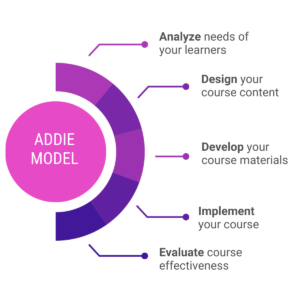 The Analysis phase involves identifying the learning needs, goals, and constraints. This phase is critical as it sets the foundation for the entire instructional design process. Understanding who the learners are, what they need to learn, and the context in which they will be learning helps designers create targeted and effective educational experiences.
The Design phase follows, where instructional designers outline the learning objectives, content, and assessment strategies. This phase focuses on planning and organizing instructional materials to ensure they align with identified needs and goals.
In the Development phase, instructional designers create the actual learning materials. This includes writing content, developing multimedia elements, and creating assessments. The Implementation phase involves delivering the training to the learners. This can be done through various methods, such as in-person training, online courses, or blended learning.
The Evaluation phase assesses the effectiveness of the instructional program. This phase involves collecting feedback, analyzing data, and making necessary adjustments to improve the learning experience. By following the ADDIE model, instructional designers can create comprehensive and effective educational programs that meet the needs of their learners.
Analysis – Analyze the needs of your learners
One of the key tasks in the Analysis phase is identifying the target audience. This involves understanding who the learners are, including their demographics, prior knowledge, and learning preferences. For example, are the learners employees who need to acquire new job skills, or students who need to master specific academic concepts?
Another important aspect of the Analysis phase is defining the learning objectives. To define effective learning objectives, instructional designers often use frameworks such as Bloom’s Taxonomy, which categorizes learning objectives into different levels of cognitive complexity.
Finally, assessing current knowledge and skills helps determine the content and activities that best address learners’ needs.
Good questions to ask include:
- What is the need to be addressed?
- Why does this training need to be done now?
- Who is the audience for the training?
- What does the audience know about the subject?
- Which tools are best for this type of information?
- How will training be evaluated for success?
- When does this training need to be completed?
Design – Design your course content
The Design phase of the ADDIE model involves creating detailed plans for achieving the learning objectives. It includes selecting the instructional strategies, designing assessments, and organizing the content.
The goal of the Design phase is to create a blueprint for the program that ensures all elements align with the learning objectives and learners’ needs.
Instructional strategies include lectures, discussions, hands-on activities, simulations, and multimedia elements. Choosing the right strategy depends on the learner and goal. For example, for a technical skill that requires hands-on practice, a simulation or lab activity might be the most effective strategy. On the other hand, for conceptual knowledge, a combination of lectures and discussions might be more appropriate.
Designing assessments is another important task. They can include quizzes, tests, projects, presentations, and practical demonstrations. Effective assessments should be aligned with the learning objectives and provide meaningful feedback to both learners and instructors.
Development – Develop your course materials
The Development phase is where the training assets are created or developed. Activities In this phase include
- Course content is written
- Course content is laid out visually
- Graphics or videos are created and recorded
- Presentation details like colours and fonts are selected
- Assessments are developed
- The course is assembled
During this phase, courses should be pilot tested for suitability and presentation, with weaknesses identified and addressed. It is also important to keep stakeholders aware of the testing and progress of the course development so they can confirm the intended purpose is being met and provide approval.
Implementation – Implement your course
The Implementation phase of the ADDIE model involves delivering the program to the learners. This phase includes preparing the learning environment, training facilitators, and providing the necessary resources and support for learners.
For in-person training, this might include arranging the classroom, setting up equipment, and ensuring that all materials are available. For online training, this might include setting up the learning management system, uploading the instructional materials, and ensuring that all technical requirements are met.
Training facilitators should be familiar with the instructional materials and learning objectives and equipped with the skills and knowledge to support learners effectively. Providing training and support for facilitators ensures that they are prepared to deliver the instructional program and address any challenges that may arise.
Providing resources and support for learners is also an important part of the Implementation phase. For example, providing access to online forums, study guides, and other resources can help learners reinforce their understanding and address knowledge gaps.
Evaluation – Evaluate its effectiveness
This phase is all about determining if the training is doing its job and learners are learning the intended material. Since the ADDIE model can be used as a continuous improvement cycle, gathered feedback can be inserted into the Analysis phase for another iteration of the course.
There are two types of evaluations to consider:
Formative evaluation involves collecting data and providing feedback during the instructional program. This might include conducting surveys, interviews, and observations to gather information about learners’ progress and experiences.
It helps instructional designers identify issues or challenges learners face and adjust the instructional program in real time. For example, if learners are struggling with a particular concept, the instructor can provide additional explanations or resources to help them understand.
Summative evaluation involves collecting data at the end of the instructional program to assess its overall effectiveness. This might include analyzing assessment results, conducting post-training surveys, and reviewing feedback from learners and facilitators.
Summative evaluation provides a comprehensive picture of how well the instructional program has achieved its learning objectives and met the learners’ needs. It also helps trainers identify any strengths and weaknesses in the program and make necessary adjustments for future iterations.
Where is the ADDIE used?
The ADDIE model is used by many instructional designers in providing technology-based programs. It is effective in designing efficient, professionally developed, high-quality distance learning programs and it is increasingly being used for corporate training and e-learning as it is a valuable for complex and large-scale training programs.
Implementing ADDIE
Here are two examples of how to implement an ADDIE training plan for a corporate environment. We have enhanced the training plans to go beyond eLearning and include instructor-led training and other modalities.
Example for corporate training
Analysis
- Determine course goals
- Work with business partners to determine outcomes
- Who will be delivering the content?
- What is timeline for creation?
- How will course be delivered? In-person, online, or hybrid?
Design
- What tools are being used to create?
- Create learning objectives
- Inventory existing content
- Write content for various learning pieces
Develop
- Create media elements – Record video, record audio, create graphics
- Create presentations, worksheets, etc. for instructor-led training
- Pilot instructor-led courses to verify timing
- Have all assets reviewed and tested
Implement
- Load to LMS or tool for delivery
- Schedule In-person sessions
- Assign learners or open registration
- Track completion
- Monitor
Evaluate
- Survey learners
- Evaluate if goals are met
- Evaluate behavior change
- Determine changes needed and revise course based on content
Example for professional development
Analysis
- Conduct focus groups/poll existing groups
- Research similar courses online
- Determine course goals/needs
- Work with business partners to determine outcomes
- Who will be delivering the content?
- What is timeline for creation?
- How will course be delivered? In-person, online, or hybrid?
Design
- What tools are being used to create?
- Create learning objectives
- Inventory existing content
- Write content for various learning pieces
Develop
- Create media elements following storyboard – Record video, record audio, create graphics
- Create presentations, worksheets, etc. for instructor-led training
- Pilot instructor-led courses to verify timing
- Have all assets reviewed and tested
Implement
- Load to LMS or tool for delivery
- Schedule In-person sessions
- Assign learners or open registration
- Track completion
- Monitor
Evaluate
- Survey learners
- Evaluate if goals were met
- Evaluate sales
- Evaluate repeat business
- Determine changes needed and revise course
- Evaluate behavior change
- Determine changes needed and revise course
FAQs
What does ADDIE stand for?
ADDIE stands for Analysis, Design, Development, Implementation, and Evaluation.
What are instructional design frameworks?
Building an efficient and effective learning environment is simpler with learning and instructional design frameworks. ADDIE, which stands for Analyze, Design, Develop, Implement, and Evaluate, serves as a guiding map to help create or revise course materials and connect learning goals with course content and assessment methods.
In other words, instructional design frameworks provide a course template for course creators that allows them to build well-structured courses that will deliver results.
What is the most important part of ADDIE?
Arguably all phases of the ADDIE model of training are important, but the Analysis phase is probably the most important one as it creates a solid foundation for the rest of the model. A thorough analysis can be used to design the training to what the audience needs, and not towards what the training instructors think they want.
Another important phase is the third phase or Development as this is the phase of ADDIE where the course content created. Storyboarding or wireframing occurs in this phase, as a precursor to the Implementation phase.
What are the advantages of ADDIE model?
ADDIE is widely accepted, used in training development and is the foundation of other learning models. It has been proven to produce effective learning and can be used to easily measure time and training costs.
ADDIE is favored by many due to its adaptability, effortless modification process, and compatibility with other models. This user-friendly approach provides an array of advantages that makes it a go-to choice for many people.
The model’s flexibility allows different steps in the process to be conducted and planned at different times. Initially considered a linear concept, it has since transformed into an iterative cycle that can successfully fulfill any project demands if developers think out of the box, employ each phase’s results, and maintain a wider perspective.
Though it may look like each stage stands alone, the five stages of the ADDIE model are in reality highly interconnected and modifiable. Developers can use one phase to inform another and determine which tasks should be executed for every step. For example, the Analysis phase directly affects the Design process while results from the Design phase might necessitate further analysis.
Finally, by incorporating ADDIE with other models, such as rapid application development (RAD) and the successive approximation model (SAM), you can create a custom learning experience that provides clear direction.
How LEAi supports the ADDIE model
LEAi is a course content creation tool designed to support the design and development phase of ADDIE.
Once the analysis of the course program is complete, cloud-based LEAI is used to generate the content needed to support development. This includes content for videos, instructor-led training, or any modality needed to support the learning program.
One of the benefits of the tool is that it can take content in one modality and automatically transform it into other forms. This means that instructional designers or course creators can let the tool transform their eLearning content into content for videos, microlearning, instructor-led training and much more – with a click of a button.
ADDIE and LEAi are valuable tools for developing great learning experiences. To learn more about how these can support you deliver better courses in less time, contact us.